Brunello Cucinelli’s AI Website Redefines Luxury Online
Next Generation ECommerce: Luxury Meets AI At Brunello Cucinelli
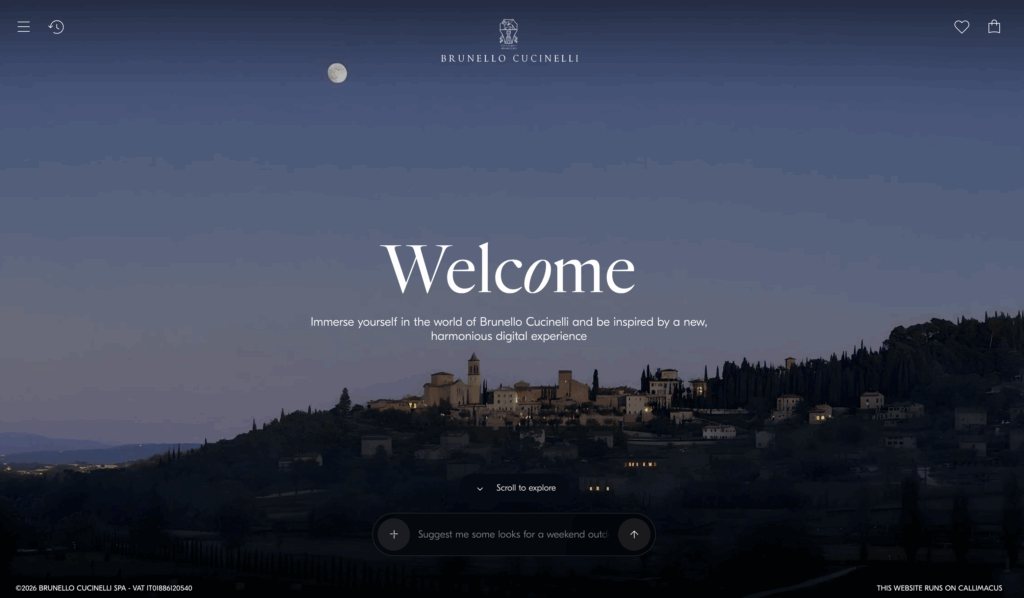
Brunello Cucinelli’s new AI-powered website is incredible. I explored it recently and, while it has some glitches, it offers an experience that mirrors the care and attention of one of their high-end boutiques.
AI and luxury have not, traditionally, paired well together. After all, true luxury demands personalized concierge care, and the ability to know, often before the customer does, what is required.
Static brochure websites don’t fully communicate craftsmanship, philosophy, and history behind a brand in a way that is immersive and responsive.
It’s one of the first times I’ve seen advanced AI used to reflect the brand’s voice and values, help people find precisely what they require AND create a sense of connection. Let’s get into it!
Curated Through AI and Impressive Taxonomy Tagging
When you first land on the website, you have a choice to engage with the guided experience by typing in what you are looking for, versus browsing the static site.
I typed in “cold weather” and the AI immediately got to work–with a pre-generated loading interaction. The curated suggestions were good, and subsequent queries of mine enabled the AI to get even more personalized (I told it I was a woman and did not want leather or fur recommendations). It delivered wool and synthetic suggestions within a few minutes.
Behind this seamless interface lies a sophisticated technological foundation developed by Callimacus, a new company specializing in some pretty cutting edge AI-driven brand experiences.
We didn’t work on this site but it is clearly powered by a comprehensive knowledge base that combines structured data, such as product details and availability, with unstructured content, including interviews, editorials, brand storytelling, and design philosophy.
A fine-tuned AI model references this knowledge base to deliver contextually accurate and coherent responses. From a content taxonomy perspective, this means a human, at some point, had to tag every item they sell in multiple ways (weather, location, gender, occasion) on top of basic category and material tagging. I love nerding out about this type of meta data tagging!

The Knowledge Base as a Foundation
The consultancy takeaway is that content is the product in AI-driven brand experiences. Without a deep and organized repository, AI cannot communicate with nuance or authority. Helping brands build and audit this content is a high-value service. Creating this likely involved:
Detailed Product Data
Collecting and organizing structured data such as product specifications, materials, sizing, availability, and pricing.
Contextual Content
Aggregating brand history, founder interviews, blog posts, fashion editorials, marketing copy, videos, social media content, and sustainability initiatives. Establishing ethical and aesthetic standards, storytelling principles, and luxury positioning rules.
Nuanced Data
Knowing your customer motivations is key, and the suggested prompts included search queries based on events or occasions. I’m going to assume that many of their customers go on the website with a specific need in mind, for example, an upcoming ski trip or an event. That means all products must contain relevant tagging to be displayed if someone types in something like “I need an outfit for apres ski drinks at the lodge in Telluride.”


Retrieval-Augmented Generation (RAG)
A key innovation that makes this experience both accurate and responsive is Retrieval-Augmented Generation (RAG). The process works as follows:
Customers type a question in their natural language.
The AI searches the brand knowledge base for all relevant documents, tagging, or content snippets.
The AI combines this information with its language generation capabilities to produce an on-brand response, likely generated from a full list of pre-loaded potential responses and brand guidelines.
This approach allows the AI to reference actual brand content rather than generating genericanswers, creating a level of authenticity and depth that mirrors a conversation with a knowledgeable stylist.
Images, videos, and related content are integrated alongside responses, providing a rich, multimedia exploration of the brand.

Why This Is Awesome For Luxury and High-Touch Brands
There are so many things to love about using AI at this level for high-touch and aspirational brands such as spas, hospitality, health and wellness, travel, and luxury Ecommerce. I feel like this type of experience replicates more of the in-store or in-person expectation.
Inspired customers seek the expertise and guidance of a personal stylist or concierge, and static digital experiences can never come close. Using AI this way also blends brand storytelling with interactivity, so it feels more premium and responsive.
This is how brands create emotional engagement: Even without purchasing, users leave with a clear sense of the brand’s identity, values, and aesthetic.
Brunello Cucinelli’s website demonstrates that digital engagement can be as meaningful and deliberate as physical interaction, or, at the very least, meet a customer’s expectations.
By combining advanced AI, a meticulously curated knowledge base, and responsive design, any brand can transform online browsing into a thoughtful, immersive, and highly personalized luxury experience.
When AI is applied thoughtfully, it can amplify the qualities of craftsmanship, service, and storytelling that define aspirational brands.